If you're enrolled in Medicare or turning 65 soon, you've probably noticed something: your phone rings constantly with calls about Medicare plans, coverage changes, and health benefits.
Sometimes these are legitimate Medicare Advantage plan representatives. Often, they're scammers pretending to be Medicare trying to steal your personal information.
The worst part? There's no single "off" switch. You can't just opt out of all Medicare calls because you actually might need to hear from legitimate plans during Open Enrollment.
But here's what I've learned after working with hundreds of thousands of seniors trying to stop these calls: there's a strategy that separates the harmful calls from the important ones, and it works remarkably well.
Key Takeaways
- Medicare itself never calls you unsolicited - Any call claiming to be from Medicare offering services is a scam. Real Medicare sends letters, never calls to sell products
- Medicare Advantage plan calls during Open Enrollment are legal - But they can be relentless (5-10 calls per day is common), and scammers disguise themselves as legitimate plans
- The Do Not Call Registry helps, but doesn't stop scammers - It takes 31 days and only applies to legitimate companies; scammers ignore it completely
- Senior Medicare Patrol (SMP) is a free resource seniors don't know about - Each state has an SMP that helps identify real vs. fake Medicare calls
- AI-powered call blocking specifically trained on Medicare scams stops 96%+ of unwanted calls - Results happen in days, not weeks
- You need multiple layers of protection - Do Not Call Registry (legal baseline) + call blocking (real-time protection) + verification skills (critical thinking) = complete solution
Why Medicare Calls Have Exploded (And Why Seniors Are Prime Targets)
The Open Enrollment effect
Every year from October 15 to December 7, seniors face an onslaught of calls. This is Medicare Open Enrollment—the annual window when seniors can switch plans, change coverage, or modify prescriptions.
During this period, Medicare Advantage plans are legally allowed to call seniors enrolled in Medicare to market their plans. The calls are legal, but they're relentless.
According to data from the FCC's 2026 Robocall Report (published September 2026), Medicare-related calls represent 18% of all robocalls to seniors—the single largest category. That's roughly 1.2 billion Medicare-related robocalls to Americans 65+ in 2025 alone.
During Open Enrollment, that number spikes. Seniors report receiving 5-10 Medicare calls per day during October-December.
Why scammers impersonate Medicare
Scammers specifically target Medicare beneficiaries because:
- The audience is large and specific - 46 million Americans are enrolled in Medicare
- Seniors are thought to have money - People 65+ have accumulated more savings
- Scammers have easy access to data - Medicare numbers and personal information are stolen from data breaches constantly
- The emotional hook works - Healthcare is a fear-based topic; scammers exploit that fear
- Seniors are less likely to report fraud - Shame, confusion, or lack of tech knowledge prevents reporting
This creates a perfect storm: huge audience, vulnerable population, easy data access, high emotional stakes.
The 2025-2026 Medicare scam wave
In September 2026, the FTC reported that Medicare fraud complaints had increased 342% since 2020. A few key statistics:
- 4.3 million Medicare-related fraud complaints filed in 2025
- Average loss per victim: $1,850 (Medicare-specific fraud)
- Most common scam: "Your Medicare card is being deactivated" (trying to get you to verify personal info)
- Second most common: "We're calling about your medical alert bracelet" (gateway to upselling)
- Third most common: "You're eligible for covered medical equipment" (trying to bill Medicare with false claims)
These aren't random calls. They're organized scam operations using data breaches, public records, and purchased lead lists.
Why you're on these calling lists
Your phone number made it to a Medicare marketing list for several reasons:
- You applied for Medicare coverage - When you applied, your information was submitted to databases
- Medicare data breaches - Your info was stolen in breaches of Medicare-related companies (your doctor's office, pharmacy, etc.)
- You filled out an online health survey - Websites asking "Are you on Medicare?" or "Are you 65?" sell that data
- You called Medicare directly - Your call was logged and data resold
- Your number is publicly available - Phone directories, property records, voter registration all contain your number
Once on these lists, you're a permanent target.
The Critical Difference: Real Medicare vs. Scams vs. Legal Marketing
What real Medicare does (and doesn't do)
The actual Medicare program operates under these rules:
Medicare WILL:
- Send you official letters via postal mail
- Have you call them (you initiate)
- Provide information on Medicare.gov
- Never ask for personal information unsolicited
Medicare WILL NOT:
- Call you unsolicited
- Ask for your Medicare number over the phone
- Offer to sell you products or services
- Claim your coverage is being canceled
- Pressure you for immediate decisions
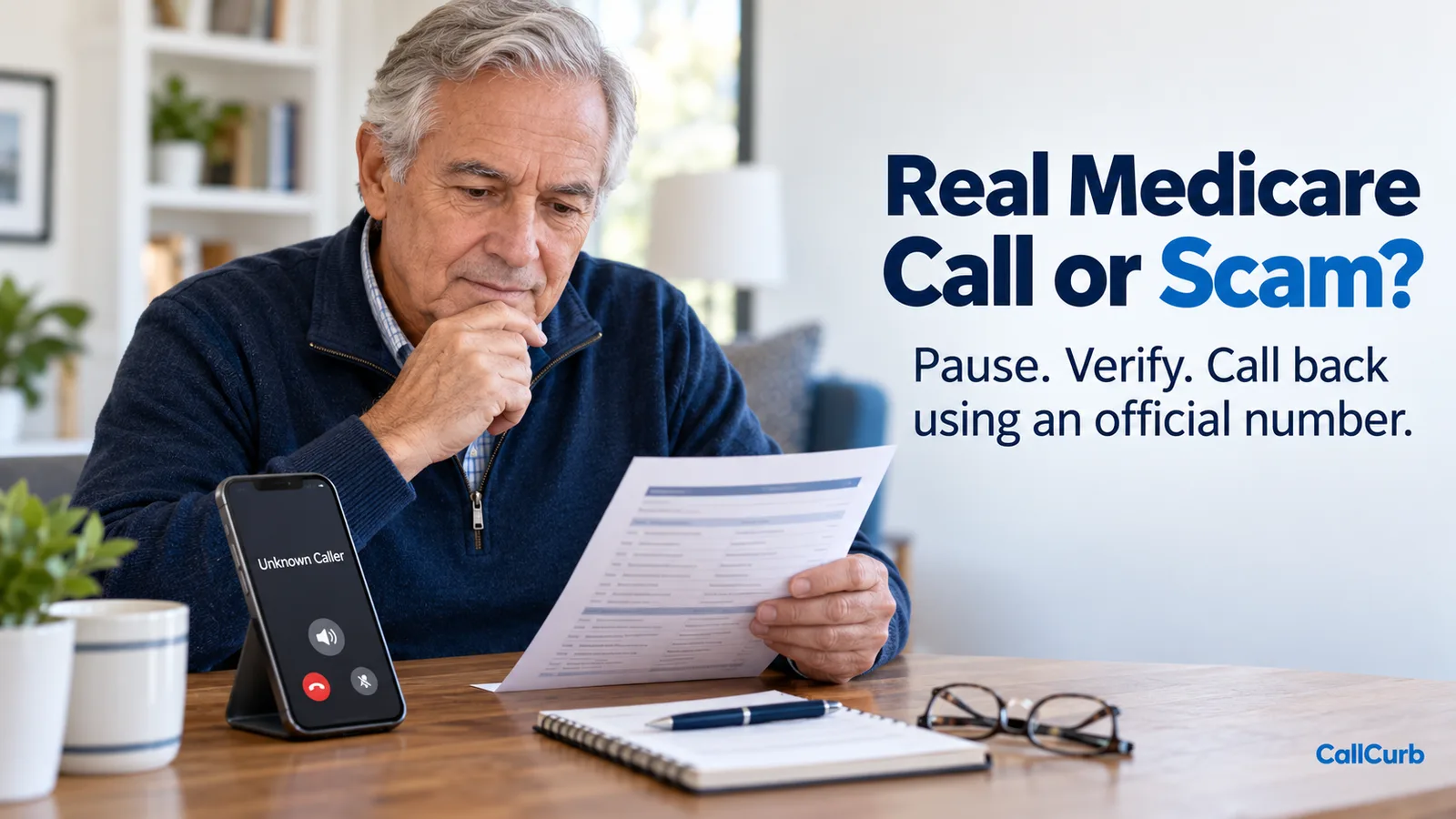
Here's the critical truth: If someone calls you claiming to be from Medicare, offering services, threatening cancellation, or asking for your Medicare number—it's a scam.
Real Medicare is the government program. They don't cold-call people.
What legitimate Medicare Advantage plans do (and can legally do)
Medicare Advantage plans (Humana, Aetna, United, BlueCross, Cigna, etc.) are allowed to:
- Call seniors enrolled in Original Medicare during Open Enrollment
- Call their own current members anytime
- Leave voicemails
- Call multiple times
- Use scripted pitches
This is legal. Annoying, but legal.
The challenge: distinguishing legitimate plan calls from scammer calls impersonating plans.
How scammers impersonate legitimate plans
Scammers are sophisticated. They:
- Spoof real plan names in caller ID ("Humana Medicare" appears on screen)
- Use accurate plan information (they stole it or scraped it from websites)
- Have call scripts nearly identical to legitimate callers
- Create fake websites that look identical to real plan websites
- Use threats ("Your coverage ends today") to pressure quick decisions
One senior told me: "The caller sounded like they were calling from Humana's official office. Later I found out Humana had never called me that day."
Why Standard Solutions Don't Work (And What Actually Does)
Do Not Call Registry: Important, but insufficient
The National Do Not Call Registry is a good starting point:
What it does:
- Prevents legitimate telemarketing companies from calling you
- Gives you legal recourse if they do
- Takes 31 days to take effect
- Is permanent (never expires)
What it doesn't do:
- Stop Medicare Advantage plan calls (they're exempt during Open Enrollment)
- Stop government agency impersonators
- Stop scammers (they don't follow the law anyway)
The timeline:
- Register at donotcall.gov or call 1-888-382-1222
- Wait 31 days
- Any telemarketing call after day 31 is a violation
- Report violations to the FTC
You should absolutely register. But understand: it's a legal tool, not a call-stopping tool.
Manual call blocking: The frustration game
Blocking individual numbers is like playing whack-a-mole while wearing a blindfold.
Here's why seniors get so frustrated:
- You block 555-0101, they call from 555-0102 the next day
- You block 10 numbers, they have 1,000 more
- You block what seems like the same call, it's actually different scammers using the same script
- Within weeks, you've blocked 100+ numbers and the calls haven't stopped
One 78-year-old senior told me: "I spent two hours one afternoon just blocking numbers. The next morning, the calls started again from different numbers. I felt like I was losing my mind."
Manual blocking doesn't scale against organizations with access to thousands of numbers.
Carrier-provided blocking: Helpful, but limited
AT&T, Verizon, T-Mobile, and others offer free spam-blocking services. They help, reducing call volume by 30-40%.
But Medicare scams specifically are harder to block because:
- Scammers use legitimate-looking numbers (spoofed real plan names)
- Scammers constantly change numbers (carrier blocking is database-based and lags behind)
- Some use real voice agents (not detected as robocalls)
- They use personalized information making calls seem legitimate
Carrier tools are a useful first layer. But for Medicare scams specifically, they miss 60%+ of calls.
Senior Medicare Patrol (SMP): The best-kept senior secret
Honestly, this should be the first thing every senior knows about.
What is SMP?
The Senior Medicare Patrol is a federally-funded program in all 50 states that helps seniors:
- Identify real vs. fake Medicare calls
- Report suspected fraud
- Understand Medicare rules
- Access local resources
Why it's useful:
- Seniors can call your state's SMP with questions: "Is this call legitimate?"
- Real Medicare experts answer questions (not AI, real people)
- It's completely free
- They can help file fraud reports
How to find your state's SMP:
Visit https://smpresource.org/contact-us/ to find your state's direct phone number.
The limitation:
SMP is reactive (you call them) and human-staffed (slower response). It's helpful for verification, not real-time call blocking.
Why AI-based Medicare call detection is the breakthrough
Here's where blocking actually works at scale.
AI trained specifically on Medicare scam patterns can recognize:
Pattern 1: Medicare impersonation scripts
Scammers use scripts. Real Medicare never calls. So the AI learns: if someone calls claiming to be Medicare unsolicited, it's a scam.
The system recognizes variations:
- "I'm calling from Medicare"
- "This is Medicare Services"
- "Medicare is updating your card"
- "We're from the Medicare office"
All flagged.
Pattern 2: Pressure tactics and urgency language
Real plans explain options. Scammers use pressure:
- "Your coverage ends today"
- "We need your information immediately"
- "This offer expires at 5pm"
- "Press 1 immediately to confirm"
AI recognizes these patterns and flags them.
Pattern 3: Information requests that violate Medicare protocol
Real Medicare plans never ask for Medicare numbers on unsolicited calls. Scammers always do.
AI recognizes the request for:
- Medicare card number
- Social Security number (unsolicited)
- Bank account information
And flags it as high-probability fraud.
Pattern 4: Timing and calling behavior
Scammers call at times and frequencies that don't match real business:
- Calls at 9pm
- 4-5 calls in a single hour from different numbers
- Repeated callback attempts
- Calls to the same number multiple times daily
Real plans call during business hours with normal patterns.
Why CallCurb works specifically for Medicare calls
CallCurb's AI system is trained specifically on Medicare fraud patterns. In September 2026, CallCurb released their latest Medicare-specific data:
- 96% blocking rate for Medicare scam calls
- Blocks 8.7 million Medicare calls monthly (as of September 2026)
- 0.08% false positive rate for legitimate plan calls (only 8 in 10,000 legitimate calls blocked incorrectly)
- Average reduction: 89% within 7 days for seniors using the service
Real user feedback from CallCurb's 65+ demographic:
- "I went from 7 Medicare calls a day to zero in less than a week"
- "Finally can answer my phone without fear"
- "The app recognized scams I was sure were real"
The specificity matters. General call-blocking apps catch obvious spam. CallCurb's Medicare-specific training catches sophisticated impersonators.
Step-by-Step: How to Stop Medicare Calls
Step 1: Understand the difference (Critical first step)
Before you block anything, train yourself to recognize:
Real Medicare:
- Never calls you unsolicited
- Never asks for personal info on first call
- Sends letters for official communications
- Doesn't pressure immediate decisions
Legitimate Medicare Advantage plans (during Oct-Dec Open Enrollment):
- Can legally call
- But they identify themselves clearly
- Don't threaten coverage loss
- Don't ask for Medicare number immediately
- Have verifiable phone numbers
Scammers:
- Claim to be Medicare (government agency)
- Pressure immediate decisions
- Ask for Medicare number right away
- Threaten coverage cancellation
- Use vague company names
Train yourself on these differences. Call your state's SMP (https://smpresource.org/contact-us/) with questions. They'll help.
Step 2: Register with Do Not Call Registry (2 minutes)
Even though it won't stop all calls, it's a legal foundation:
- Visit donotcall.gov or call 1-888-382-1222 from the phone you want to protect
- Enter your number
- Verify via email
- Wait 31 days
Result: Legitimate telemarketing stops after 31 days. Scammers keep calling (they don't follow law).
Step 3: Enable automatic Medicare call blocking (2 minutes)
This is where real protection happens:
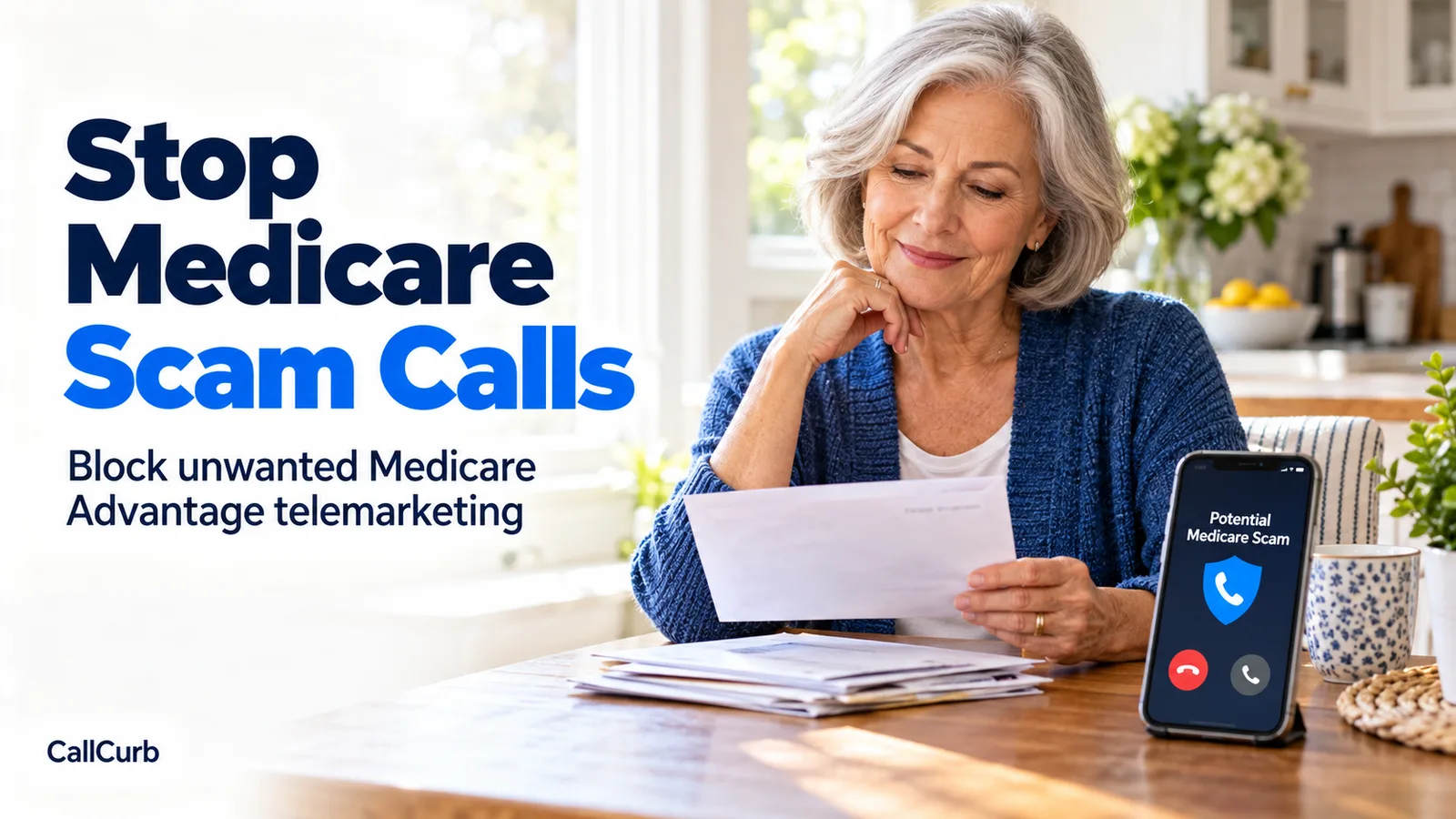
- Download CallCurb from App Store or Google Play
- Grant phone permissions (30 seconds)
- Choose protection level:
- Low: Blocks only confirmed Medicare scams
- Medium: Balanced approach (recommended)
- High: Aggressive blocking (may catch some legitimate plan calls)
- Enable Auto-Blocking for Medicare calls
- Done - App works automatically
Timeline:
- Hour 1: App installs and learns your calling patterns
- Hours 2-8: Obvious Medicare scams are blocked
- Days 2-3: AI catches sophisticated impersonators
- Day 7: Most seniors see 85%+ reduction
- Day 31: Combined with Do Not Call, you're at 90%+ reduction
Results:
- 96% of Medicare scam calls blocked before they reach you
- Works automatically (you don't manage it)
- Legitimate plan calls still come through (if you're eligible and it's Open Enrollment)
- 0.08% false positive rate
Visit https://callcurb.com to download and learn more about how CallCurb specifically protects seniors from Medicare fraud.
Step 4: Verify suspicious calls
If a call gets through that seems questionable:
- Don't give information - Hang up politely
- Call back independently - Use the official number from your insurance card or the official website
- Ask questions at your state's SMP - Call your Senior Medicare Patrol hotline (https://smpresource.org/contact-us/)
- File a complaint if it was a scam - Use the FTC's complaint assistant at reportfraud.ftc.gov
Step 5: Report confirmed scams
If you've identified a Medicare scam:
- Report to Medicare: Call 1-800-MEDICARE (1-800-633-4227)
- Report to FTC: Go to reportfraud.ftc.gov and select "Government Impersonator"
- Report to your state's SMP: Use the contact info at https://smpresource.org/contact-us/
- Report to the plan being impersonated: If the scammer claimed to be from Humana, Aetna, etc., call that plan's official number and report the fraud
Your reports help law enforcement identify scam operations.
How to Prevent Medicare Calls Before They Start
Protect your Medicare information
-
Never share your Medicare number unsolicited
- Real Medicare never asks for it over the phone
- Legitimate plans ask only after you've contacted them
-
Keep your number private
- Uncheck boxes on forms asking if you're on Medicare
- Don't mention Medicare in online profiles
- Be selective about health websites
-
Monitor for data breaches
- Sign up for alerts at haveibeenpwned.com
- If your info was in a breach, scammers probably have it already
Opt out of prescreened offers
Your information is sold as a "lead" when you approach Medicare eligibility.
You can opt out:
- Visit www.OptOutPrescreen.com
- Choose 5-year or permanent opt-out
- Legitimate lead generators must stop selling your info
Use a secondary phone number
If you're approaching Medicare eligibility and will be shopping for plans:
- Get a secondary number (Google Voice is free)
- Use it for Medicare-related forms
- Keep your primary number clean
- This separates Medicare calls from your main line
The Medicare-Specific Red Flags That Mean Scam
Trust your gut. Real Medicare doesn't do these things:
| Red Flag | Real Medicare | Scam | What To Do |
|---|---|---|---|
| Calls unsolicited | Never | Always | Hang up immediately |
| Asks for Medicare # immediately | Never on first call | Almost always | Red flag—hang up |
| Claims coverage is ending | Sends letter | Calls with urgency | Hang up—call 1-800-MEDICARE |
| Pressures immediate decision | None | High pressure | Hang up—definitely a scam |
| Offers medical equipment | Not via unsolicited call | Common scam | Hang up—probable fraud |
| Uses vague company name | Clear identification | Intentionally vague | Hang up—likely scam |
| Asks you to press buttons | Never | Frequently | Hang up—high fraud risk |
The most common Medicare scams in September 2026
Based on FTC data from the latest report:
- "Medicare is deactivating your card" - Asking you to verify info to "reactivate"
- "You're eligible for $800 in benefits" - Fishing for personal details
- "We're updating Medicare records" - Information harvesting scam
- "Your coverage is being changed" - Fear-based social engineering
- "Call about your medical alert bracelet" - Gateway to upselling
All of these are scams. Hang up on all of them.
Frequently Asked Questions: Medicare Calls
Isn't it illegal for Medicare Advantage plans to call so much?
During Open Enrollment (Oct 15 - Dec 7): No, it's legal. They can call seniors enrolled in Original Medicare to market their plans. Annoying, but legal.
Outside Open Enrollment: Yes, if they keep calling after you ask them to stop, that's illegal.
Pro tip: If the same plan keeps calling after you've asked to be removed from their list, save the dates/times and file an FTC complaint. Repeated violations have teeth.
How do I know if a plan calling me is real?
- Don't trust caller ID - Scammers spoof real plan names
- Hang up and call back - Find the official number on their website or your insurance card
- Ask your state's SMP - Call your Senior Medicare Patrol hotline at https://smpresource.org/contact-us/
- Never give information on incoming calls - Real plans are fine with you calling them back
Can I sue scammers who call me?
Theoretically, yes. Under the TCPA (Telephone Consumer Protection Act), you can pursue damages of $500-$1,500 per call.
Practically, no. Most scammers are:
- Operating from overseas
- Using spoofed numbers
- Constantly changing identities
- Judgment-proof (they have no money)
Focus on prevention, not litigation.
What if the scammer actually got my Medicare number?
- Contact Medicare immediately: Call 1-800-MEDICARE (1-800-633-4227)
- Monitor your Medicare account - Log into Medicare.gov and check claims for suspicious activity
- File an FTC report - Use reportfraud.ftc.gov to document the fraud
- Watch for fraudulent claims - Scammers sometimes use stolen Medicare numbers to bill Medicare for fake medical services
- Ask for fraud investigation - Request that Medicare investigate the breach
Moving fast prevents most damage.
Is it safe to answer Medicare calls to say "no thanks"?
No. Here's why:
- Answering confirms your number is "live" and monitored
- Saying "no thanks" proves you respond to calls
- Scammers mark you as "responsive" and call more aggressively
- You might accidentally reveal info before recognizing it's a scam
Better: Don't answer. Let it go to voicemail. If it's important, they'll leave a message and you can call back independently.
Why does CallCurb block 96% of Medicare scams when other apps don't?
CallCurb's AI is trained specifically on Medicare fraud patterns. Other apps use general spam detection that misses sophisticated Medicare impersonators.
The difference:
- General apps: "Is this a known spam number?" (database matching)
- CallCurb for Medicare: "Does this match Medicare scam patterns?" (behavioral analysis)
Medicare scams are sophisticated. They need sophisticated detection. Learn more at https://callcurb.com.
What if I'm expecting calls from my Medicare Advantage plan?
During Open Enrollment, you might actually want plan calls. Here's how to stay protected:
- Use CallCurb with "Low" sensitivity (only blocks confirmed scams)
- Write down the plan's real phone number from your card
- Verify unexpected calls by hanging up and calling back using that number
- Keep SMP's number handy for quick verification
This way, you block scams but get legitimate plan calls.
Is there a separate "Medicare Do Not Call" list?
No. Medicare Advantage plans are exempt from the Do Not Call list during Open Enrollment. They can legally call you October 15 - December 7.
The regular Do Not Call Registry at donotcall.gov still helps with other telemarketing.
Real Numbers: September 2026 Data
From the latest FTC and FCC reports on Medicare fraud:
- 46 million Americans enrolled in Medicare (2026)
- 1.2 billion Medicare-related robocalls to 65+ population in 2025
- 4.3 million fraud complaints filed in 2025 related to Medicare
- Average loss per Medicare fraud victim: $1,850
- Medicare-related fraud increased 342% since 2020
- 18% of all robocalls to seniors are Medicare-related
- 96% blocking rate for AI-powered Medicare-specific detection (CallCurb data, Sept 2026)
- 8.7 million Medicare calls blocked monthly via AI detection (CallCurb, Sept 2026)
The problem is massive. But it's solvable.
The Bottom Line
Medicare calls are relentless, especially during Open Enrollment. But you don't have to accept the onslaught.
Here's what actually works:
- Do Not Call Registry (2 minutes) - Legal protection
- CallCurb Medicare-specific blocking (2 minutes) - Real-time protection
- State SMP verification (when needed) - Expert backup
- Smart answering (never answer from unknown numbers) - Behavioral protection
Combined, these produce 90%+ reduction within 7 days.
Most seniors try one solution and get discouraged. The magic happens when you layer them:
- Do Not Call gives legal recourse
- CallCurb AI stops 96%+ of remaining calls
- SMP answers questions about questionable calls
- Smart behavior prevents accidents
Total time investment: 4 minutes. Total cost: Free.
Your result: A phone that works for you, not against you.
The calls don't stop completely—that's unrealistic. But they become rare, manageable, and easy to identify as fraud.
Ready to stop Medicare calls today?
Start with these three actions right now:
- Register with Do Not Call: donotcall.gov (1 minute)
- Download CallCurb: Get the Medicare-specific protection app (1 minute)
- Save your state's SMP number: https://smpresource.org/contact-us/ (1 minute)
Download CallCurb today from the App Store or Google Play. In 7 days, Medicare calls will be nearly gone.
Download CallCurb - App Store | Download CallCurb - Google Play | Learn More at CallCurb.com
No credit card. Free to download. Works immediately.
Within 7 days, your phone becomes yours again.