How to Stop Car Insurance Spam Calls in 2026: Why Auto Brokers Keep Calling (And How to Shut Them Down)
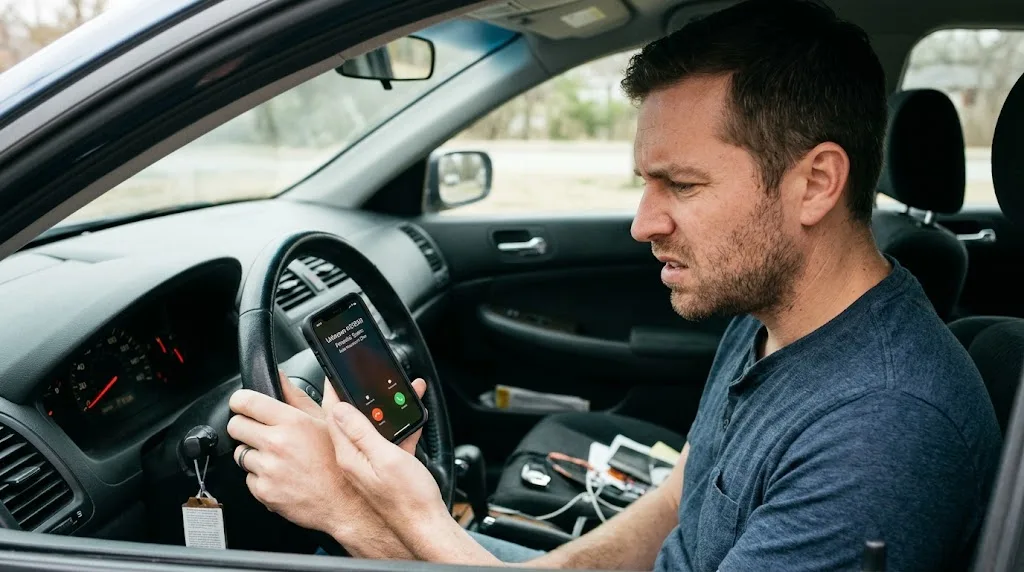
We have all been there. You are sitting at your desk trying to finish a project, or waiting for an important call from family, when your phone buzzes with an unfamiliar local number. You pick up—just in case—and hear that familiar hollow pause before a recorded voice kicks in: "Hello! We offer special auto insurance rates as low as $29 per month with carriers like State Farm, GEICO, and Liberty Mutual. Press 1 to speak with a licensed agent."
You hang up and block the number. Two hours later, the exact same pitch calls back from a brand-new number with your local area code.
Americans received 52.5 billion robocalls in 2025, with telemarketing and scam calls jumping 15.4% year-over-year to reach 29.6 billion calls (YouMail Robocall Index). Because car insurance is mandatory in 48 states and standard policies average well over $815 to $2,500 per year, auto insurance lead brokers and offshore call centers view American drivers as their most profitable target.
If you are wondering how to stop car insurance spam calls for good, blocking individual numbers one by one will never work. Below is the complete legal, technical, and app-level guide to wiping your phone number from auto broker dialers and reclaiming your peace and quiet.
Quick Summary: Key Takeaways for Stopping Auto Spam Calls
- The 57% Telemarketing Surge: Out of 52.5 billion robocalls placed across the U.S. in 2025, 57% (29.6 billion) were telemarketing or scam attempts—a pace that continued with 32.7 billion robocalls recorded between January and August 2026 (YouMail Robocall Index).
- Why Car Insurance Calls Exploded After Late 2025: The 11th Circuit Court of Appeals struck down the FCC's "One-to-One Consent" rule in Insurance Marketing Coalition Ltd. v. FCC, forcing the FCC to formally repeal the rule in September 2025 (Consumer Finance Insights). Today, filling out a single online car insurance quote form allows lead aggregators to legally sell your phone number to dozens of call centers at once.
- Never Press "1" or "9" on a Robocall: Interacting with an automated dialer immediately flags your phone number as an active, live human lead, increasing its resale value on third-party data exchanges.
- Combine Legal Opt-Outs With Smart Call Filtering: Pair a National Do Not Call Registry listing and an OptOutPrescreen credit freeze with a dedicated iOS and Android call blocker like CallCurb to stop local area code spam calls before your phone ever rings.
Why Do Auto Insurance Companies Keep Calling Me All of a Sudden?
Auto insurance companies and third-party telemarketers keep calling your cell phone because online comparison sites bundle and resell your contact details through real-time lead auctions the moment you search for rates. Following the federal court ruling in Insurance Marketing Coalition Ltd. v. FCC, 127 F. 4th 303 (11th Cir. 2025), the FCC officially eliminated its One-to-One Consent requirement in September 2025—meaning a single buried checkbox on a quote website can legally authorize dozens of separate insurance agencies to robocall your phone (Consumer Finance Insights).
When you type your phone number into a "compare cheap car insurance rates" website, your data enters an automated distribution network called a ping-tree. Within milliseconds, the lead broker auctions your phone number to sub-tier call centers, independent agents, and overseas dialers.
Even if you have not shopped for car insurance recently, your number usually lands on these auto dialer lists through four hidden triggers:
- The "Soft Consent" Fine Print Trap: Entering your phone number on auto loan calculators, dealership trade-in estimators, or online sweepstakes almost always includes a tiny disclosure allowing the site to share your data with "marketing partners."
- Credit Bureau Prescreening Lists: Insurance underwriters monitor soft credit inquiries through Experian, Equifax, TransUnion, and Innovis to spot drivers whose policies are nearing renewal or who recently financed a car.
- Recycled Cell Phone Numbers: Roughly 35 million U.S. phone numbers are disconnected and reassigned every year. If the previous owner of your number requested auto quotes, their telemarketing profile remains tied to your line.
- Neighbor Spoofing & Non-IP Gateways: Scammers disguise their caller ID to match the first six digits of your own phone number so you think a local mechanic or neighbor is calling. According to the FTC's December 2025 Biennial Report to Congress, illegal robocallers route calls through legacy non-IP telephone networks to strip away digital STIR/SHAKEN caller ID verification fingerprints (FTC Report to Congress).
Which U.S. States Get Hit Hardest by Auto & Telemarketing Robocalls?
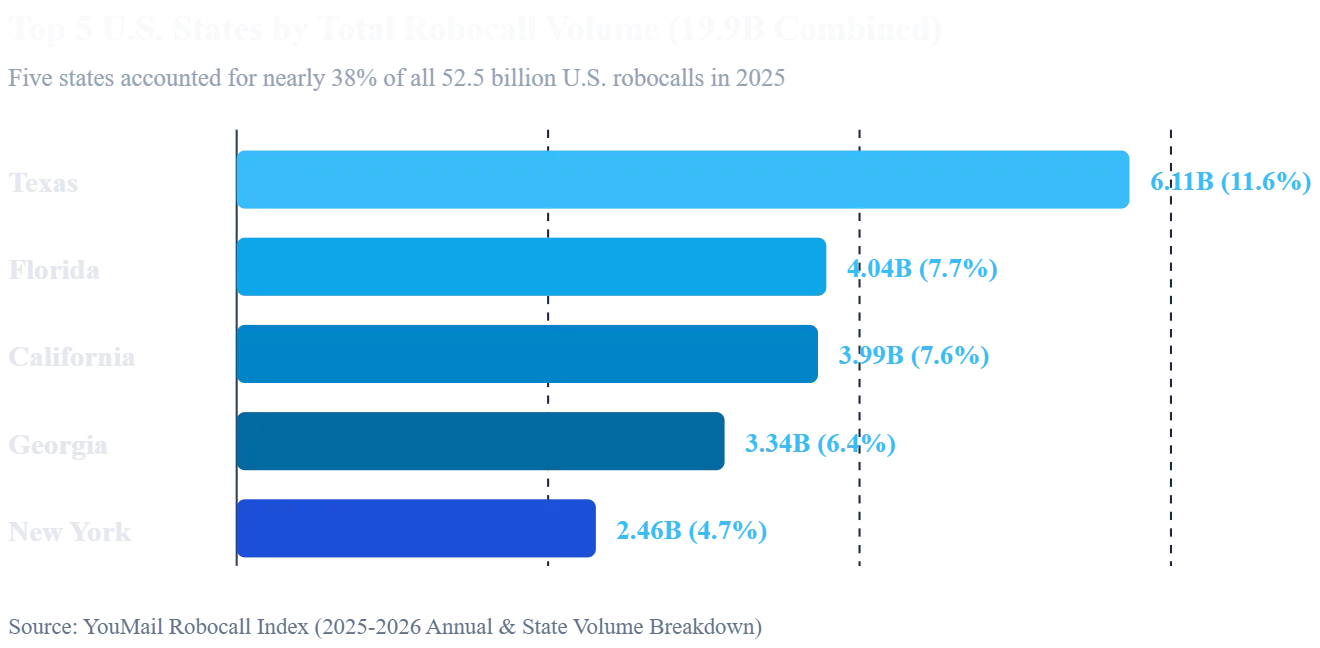
Drivers living in heavily populated states with high auto insurance premiums experience the highest volume of daily robocalls. According to state-level call tracking data from the YouMail Robocall Index and the FTC's Fiscal Year 2025 National Do Not Call Data Book, five states absorbed nearly 19.9 billion robocalls (38% of the entire U.S. total):
- Texas: 6.11 billion robocalls (11.6% of all U.S. robocalls, averaging roughly 522 million calls per month).
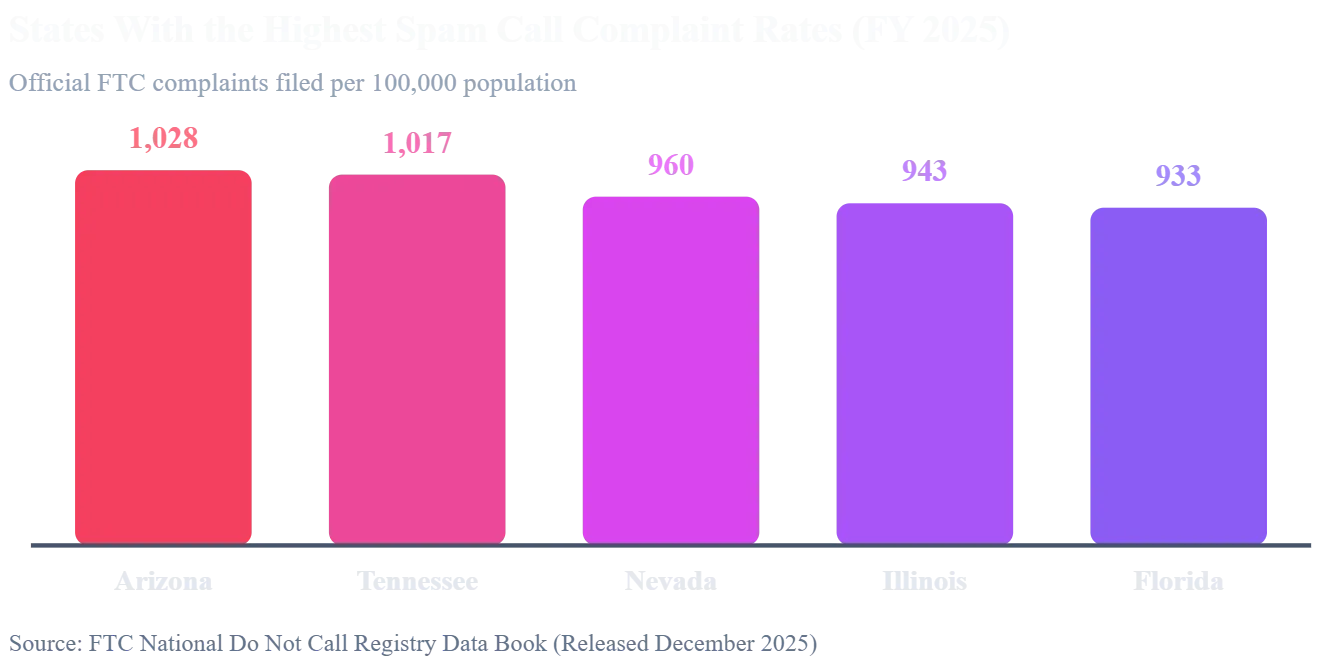
- Florida: 4.04 billion robocalls (7.7% of the national total, alongside 933 official FTC Do Not Call complaints per 100,000 residents).
- California: 3.99 billion robocalls (7.6% of the national total).
- Georgia: 3.34 billion robocalls (6.4% of the national total).
- New York: 2.46 billion robocalls (4.7% of the national total).
- Highest Per-Capita Complaint Hotspots: Arizona (1,028 complaints per 100,000 residents), Tennessee (1,017 per 100k), Nevada (960 per 100k), and Illinois (943 per 100k) led the country in official consumer harassment filings (FTC DNC Data Book FY 2025).
How to Spot Fake Auto Insurance Robocalls vs. Legitimate Agents
Fraudulent car insurance robocalls rely on prerecorded voicemails promising unrealistically cheap "$29-a-month" policies while refusing to name a licensed underwriting company. Real auto insurance companies do not cold-call drivers with generic robotic recordings unless you hold an active policy or directly requested a callback from a specific local agent.
Watch out for these red flags that prove an incoming car insurance call is a scam or an aggressive lead harvester:
- They Claim to Represent Multiple Competing Carriers at Once: A legitimate captive agent from State Farm or GEICO cannot sell you policies from three rival companies on the same call.
- They Ask for Your Social Security or Driver's License Number Immediately: Unlicensed offshore call centers use fake auto insurance quotes to harvest identity theft data or banking details.
- They Use High-Pressure "Live Transfer" Scripts: A low-tier dialer asks two basic screening questions ("Do you currently have auto insurance?" and "Have you had any DUIs in the last 3 years?") before rushing to transfer you to a "senior specialist." These call centers get paid $25 to $60 per live transfer.
For a deeper look into the exact scripts telemarketers use across auto, property, and life policies—and how to shut down their lead pipelines—read our complete guide on how to stop insurance spam calls.
How to Stop Car Insurance Spam Calls Permanently (6 Proven Steps)
Stopping car insurance spam calls requires cutting off data brokers at the source while blocking spoofed VoIP dialers on your smartphone. In Fiscal Year 2025 alone, Americans added 4.8 million new phone numbers to the federal registry, bringing total active protections to 258.5 million numbers (FTC DNC Data Book FY 2025). Follow these six steps in order to silence your phone.
1. Use Your Federal "Any Reasonable Means" Right to Revoke Consent
Under the Telephone Consumer Protection Act (TCPA, 47 U.S.C. § 227) and the FCC's strengthened Consent Revocation Rules, you have the legal right to revoke prior express consent at any time using any reasonable method (FCC Consumer Policy Division).
- If a real U.S. insurance brokerage calls you: Do not just hang up. Say clearly: "I revoke all prior express consent to receive calls or texts at this phone number. Put my number on your internal company Do Not Call list immediately and state your company's legal name."
- Why this works: Legitimate U.S. insurance agencies must honor consent revocation within 10 business days or face statutory TCPA lawsuits ranging from $500 to $1,500 per violation.
2. Opt Out of Insurance Credit Triggers at OptOutPrescreen.com
Auto insurers constantly buy prescreened consumer lists from the major credit bureaus to cold-call drivers whose credit tiers or auto loan balances change.
- Visit OptOutPrescreen.com (the official portal operated by Equifax, Experian, TransUnion, and Innovis).
- Select the 5-Year Electronic Opt-Out to legally bar insurance companies and lenders from pulling your credit file for unsolicited telemarketing offers.
3. Register on DoNotCall.gov and Report Spoofed Numbers
Confirm that your mobile number is registered on the FTC's National Do Not Call Registry. While offshore scammers ignore the registry, reporting illegal car insurance calls on DoNotCall.gov still works in your favor: the FTC publishes reported spam numbers every single business day to telecom carriers and call-blocking app developers so their algorithms can blacklist the scammer's VoIP gateway.
4. Turn On Built-In iPhone and Android Call Filtering
Both Apple and Google provide built-in settings that silence unrecognized callers before they interrupt your day:
- On iPhone (iOS): Go to Settings > Apps > Phone > Silence Unknown Callers and toggle the switch On. Any number not in your Contacts, recent outgoing calls, or Siri suggestions is sent quietly to voicemail.
- On Android: Open your Phone app, tap the three-dot menu, and go to Settings > Caller ID & spam. Toggle on both See caller and spam ID and Filter spam calls.
5. Use a Dedicated Mobile Call Blocker to Stop Local Spoofing
Built-in phone switches have one major drawback: turning on Silence Unknown Callers can cause you to miss important calls from your mechanic, courier, or doctor's office, while basic carrier filters let neighbor-spoofed numbers slip right through.
- Why dedicated app filtering wins: Installing a specialized mobile spam blocker like CallCurb gives you precision control over your phone line on both iOS and Android. Instead of blindly muting every unknown caller, CallCurb uses real-time caller identification, customizable block sensitivity, automated SMS spam filtering, and community-driven spam reporting to intercept rotating auto insurance robocalls before your screen even lights up.
6. Remove Your Phone Number From Public Data Brokers
Lead aggregators verify whether a cell phone number belongs to a car owner by scraping public people-search sites like Whitepages, Spokeo, Radaris, and BeenVerified. Submit free opt-out requests on major data broker directories so telemarketers can no longer match your license plate or home address to your mobile number.
Why Car Insurance Leads Trigger Health & Medicare Spam Calls
Once an auto insurance dialer marks your phone number as an "active line that answers unknown calls," data brokers cross-sell your contact profile to healthcare, medical clinic, and debt relief telemarketers. According to the FTC's FY 2025 Do Not Call Data Book, Medical & Prescriptions ranked as the third largest spam complaint category in the United States with 208,228 official consumer complaints (NumberVerifier / FTC Data Book).
If you answered even a single car insurance spam call recently, you will likely see a secondary wave of health telemarketing:
- Seasonal Healthcare & Medicare Advantage Spammers: Lead brokers repackage active driver lists and sell them to health insurance call centers. If you want to block health insurance telemarketers and seasonal open-enrollment dialers, check out our dedicated guide on how to block Medicare calls in 2026 for targeted opt-out steps.
- Relentless Medical Clinic Robocalls: Many consumers notice that interacting with an auto insurance or extended warranty robocall triggers non-stop callbacks from spoofed healthcare clinics. If you are dealing with daily medical center harassment, read our step-by-step breakdown on what to do when Infinity Health Clinic keeps calling you to shut down their rotating dialer blocks.
Frequently Asked Questions (FAQ)
Why am I getting 10 car insurance spam calls a day all of a sudden?
A sudden spike to 10 or more calls a day happens when your phone number enters an automated "ping-tree" lead auction after you submit an online quote form, or when you accidentally answer a random test robocall. Because the FCC repealed the One-to-One Consent rule in September 2025 following the 11th Circuit Court ruling, a single comparison form submission can legally be sold to dozens of insurance agencies at the exact same time.
Does pressing 2 or 9 remove me from car insurance call lists?
No—pressing any button on an illegal prerecorded robocall confirms to the autodialer software that a live human monitors the line. Instead of removing you, the software flags your number as a high-value active target and resells it to other telemarketing networks.
How can I shop for car insurance online without getting spammed?
Never enter your real cell phone number on third-party "compare 20 insurance companies at once" websites. Request quotes directly on the official website of the specific insurance company you want to use, or create a free disposable virtual phone number (such as a temporary Google Voice or burner number) strictly for online quote forms.
Are prerecorded car insurance calls illegal in the United States?
Yes, unless you provided prior express written consent. Under the federal Telephone Consumer Protection Act (TCPA), telemarketers are strictly prohibited from using automated dialing systems or prerecorded voices to call cellular phones without written permission—and you can legally revoke that permission at any time.
Take Back Control of Your Phone Today
You do not have to let aggressive auto brokers and offshore spoofers hijack your phone every afternoon. By locking down your credit prescreening profile, revoking TCPA consent, keeping your number on the National Do Not Call Registry, and installing an intelligent call blocker like CallCurb, you can filter out telemarketers automatically. And if you want a complete master checklist for stopping every type of insurance telemarketer, read our full resource on how to stop insurance spam calls so your phone only rings when it actually matters.